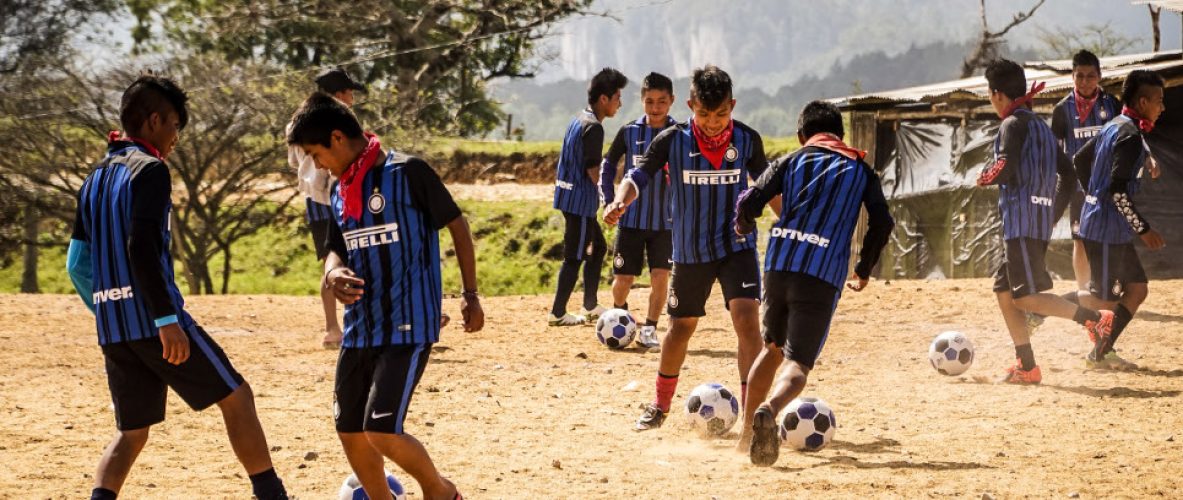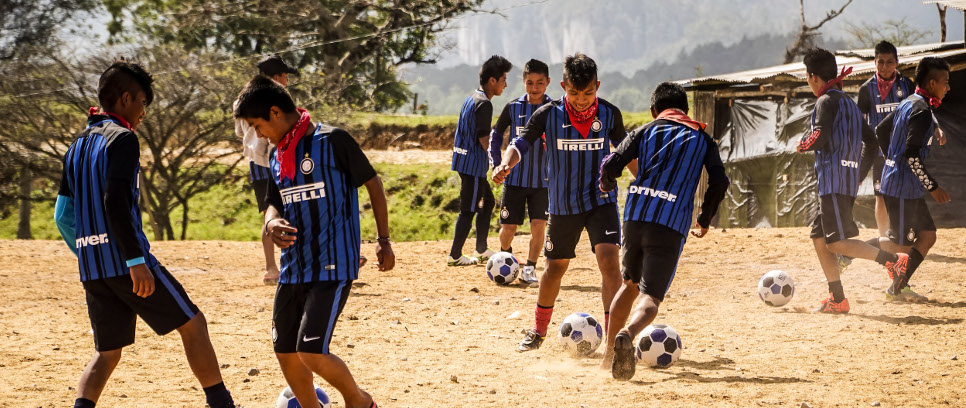




For approximately 15 years, Inter Campus has been active in Mexico; over the last ten, projects have been initiated in various areas of the Republic, each with particular social needs that are often similar. The high crime rate and drug trafficking increase the population’s sense of fear, and the continuous search for better living conditions fuels the constant migratory flow towards the United States and Canada. Inter Campus’s intervention in the country shares the common denominator of prevention through individual development. The tools utilized are the game of football and the technical training of local coaches, carried out over time by our staff.
Every project in the 30 countries where we operate is unique, but one of these is different from all the others: Chiapas. It is one of the 31 states that make up the Republic of Mexico, counted among the poorest despite actually being the richest in terms of natural resources. Minerals, gas, oil, as well as great hydroelectric potential, are almost exclusively exploited by foreign companies under municipal concessions. Its agricultural production is notable, not only for major crops like coffee, corn, and fruit. The cultivation of African palm (from which biodiesel fuel is derived) is rapidly increasing, threatening both food sovereignty and the forest itself. Biodiversity is concentrated in “protected” natural areas such as the “Biosfera de Monte Azules,” which includes the “Selva Lacandona” reserve, one of the last tropical forests in the northern hemisphere of the planet. This territory also suffers from exploitation by extensive cattle ranching and the logging of precious timber. Despite this wealth, most of its population today lives in a state of severe poverty, especially in mountainous areas, and is increasingly affected by serious malnutrition-related pathologies. It is precisely here, between the Selva and the highlands of Chiapas, that the Inter Campus project has developed since 2012. This territory is a transit point for hundreds of thousands of citizens from South and Central America who cross the Mexican border from Guatemala. All are pursuing the dream of a better life that can guarantee them a minimum of subsistence and economic security. Endless caravans of human beings of all ages flee from countries where violence rates are skyrocketing and human rights are trampled daily. Social inequality is progressively fueled by widespread corruption. A humanitarian emergency that causes a mass exodus towards the north of the continent.
It is within this reality that the Inter Campus project was activated, in support of the Zapatista indigenous communities. An indigenous organization that, after 500 years of colonial subjugation, began to rebel in 1994, organized and led by the academic intellectual Subcomandante Marcos, a fan of Inter and the Chiapas Jaguars, in a country where indigenous peoples were forgotten by the Republic, cut off from the political agenda.
Since our arrival in Chiapas in 2012, before reaching the Caracol (a Zapatista institutional place, defined by Marcos as “a door to enter the community and from which communities exit; a window to look inside and to look out; a loudspeaker to launch our word and to hear what comes from afar, but above all to remind us that we must watch and be attentive to what happens in the world”), we pass through the colonial town of San Cristobal de las Casas. It is saddening to see how many descendants of the Maya, day and night, wander the streets of the town trying to sell their wares to tourists. Children as young as 3 years old, as well as elderly adults, not belonging to the Zapatista system, in beautiful traditional Tzeltal, Tzotzil, Tojolabal attire, sitting on the ground, waiting at the exit of various hotels or chasing tourists with their canopies to sell all kinds of products. It makes one think that despite the increase in tourism, their sad history of the last 500 years and their social condition has not changed much. Mass tourism has a strong impact on local indigenous culture. Many children are deprived of education as they are often considered a source of income for their families. To oppose all this, the Zapatistas have asserted their demands for self-governance and justice and organized their own health and education system (guaranteeing basic education to all members of the organization), as well as their own production practices based on collective land ownership and the development of new forms of collective work, which have allowed them to materially sustain the organization of autonomy.
In response to governmental mega-projects for tourism development that threaten the Zapatista communities and their territories, 11 new centers of autonomous resistance have been built—seven Caracoles and four municipalities—thereby increasing internal tension. Following these developments, the safety of our staff has been put at risk, and since the beginning of 2020, they have suggested we suspend the project.
It is not easy to hide how much we miss our “compas” friends, both off and on the field, their red scarves, their courage, their gentle and selfless ways, their innate values, their sharing, brotherhood, altruism, courage, discipline, and the dignity in their gaze and behavior.
Our message is that when they decide it is time again, we will continue to be there; we have never stopped being there. We will continue to support the development of the Zapatista indigenous educational system and to “compartir” (share) time and knowledge with them.
Zapatista message: “We invite you not to lose human contact, but rather to temporarily change the ways of knowing each other as sisters and brothers. The word and listening, with the heart, have many paths, many ways, many calendars, and many geographies to meet. And this struggle for life can be one of them.”