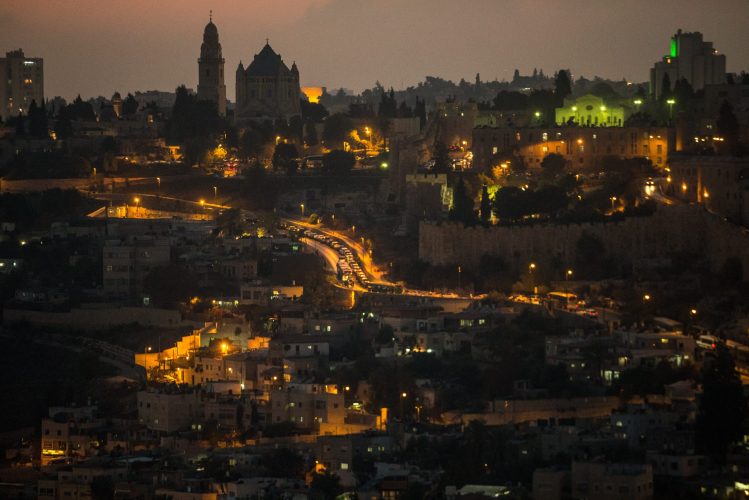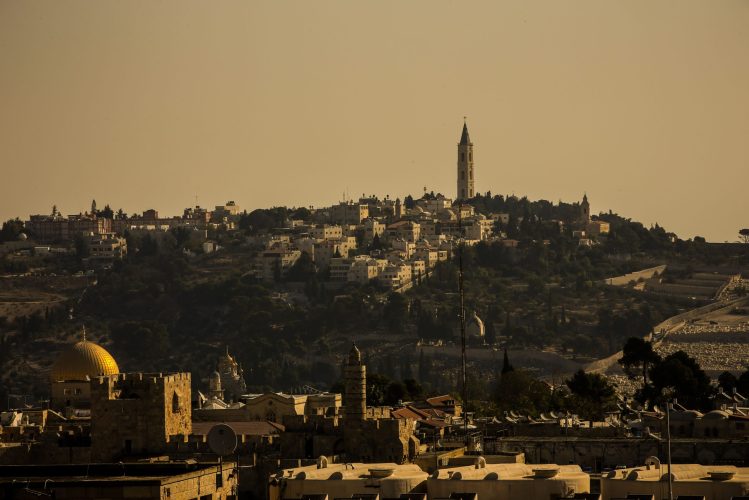

Between Abu Tor and Bet Zafafa, Inter Campus has established its site for sports and educational outreach for 60 Israeli and Palestinian children; located along the Hebron Road in South-East Jerusalem, just a stone’s throw away from the Wall, these two projects are deeply rooted in their respective millennia-old Arabic and Israeli cultures, which have united today to fight the common enemy of COVID-19.
Abu Tor (father of the bull in Arabic), which according to local legends was the site of the house of the high priest Caiaphas where Judas betrayed Jesus just under 2000 years ago, stands on a hill about 800m above sea level; it developed under Ottoman rule as a residential district where Arabs and Christians lived side-by-side in Jerusalem. The ancient border between Israel and Jordan was located here from Israeli independence up until 1967, serving metaphorically as a cultural and religious meeting point between the Jewish and Muslim communities.
Today, it remains one of the few districts of Jerusalem with a mixed Arab and Jewish population, where synagogues and mosques stand side-by-side in a landscape completed by the homes of diplomats and United Nations employees, as if to symbolize the mediation between cultures and to represent the area’s characteristic heterogeneity of customs and traditions.
A little further north is the Gehenna (Kidron Valley), a mythological and holy site of the Holy City par excellence, which connects Abu Tor to Mount Zion; thinking metaphorically about the balls kicked by children in black and blue jerseys, one might envision an almost mythological connection between the past, the present, and the future. This is a future that still seems very uncertain, caught between potentially risky choices for the peace process—such as the annexation of Palestinian territories—and a pandemic that is currently bringing a second wave to these lands.
Much like Abu Tor, Bet Zafafa (house of the summer) also developed along the Green Line, divided between East Jerusalem and a small portion in the western part of the city; split between Jordanian law (the eastern part) and Israeli law (the northern part), its origins date back to the Crusades. Subsequently divided and contested during various Arab-Israeli wars, it found its place after the Six-Day War, allowing different ethnic groups a coexistence that continues to this day. Located just steps from the Wall, Bethlehem, Beit Sahour, and Beit Jala, it carries both history and modernity, embodying the idea of a cultural crossroads like few other points in the city. The young girls of Inter Campus, well-educated in the local schools, nearly all speak three languages, symbolically representing the development and multifaceted nature of an area that looks toward the future while carrying a recent past; situated between the Green Line and the Wall with Palestine, the community has learned to coexist through conflict and mediation, finding a unique identity that is essential for future generations.